

California lemon law arbitration in 2026 gives some vehicle owners a way to resolve manufacturer warranty disputes without immediately pursuing a court case. When a car repeatedly develops serious problems, consumers may struggle to obtain a lasting repair or a clear response from the manufacturer.
An arbitration program allows eligible consumers to present evidence about the vehicle, warranty, and repair history to a neutral decision-maker.
California’s Department of Consumer Affairs certifies and monitors certain manufacturer arbitration programs. These state-certified programs must meet applicable requirements, and consumers can access them without paying an arbitration fee.
However, certification does not mean every manufacturer participates. Nor does arbitration guarantee a refund, replacement, or favorable decision.
This guide explains eligibility, preparation, hearings, and how arbitration differs from other lemon law procedures.
How California Lemon Law Arbitration Works
Arbitration uses a structured dispute-resolution process rather than a conventional courtroom trial.
The consumer describes the warranty problem and presents supporting documents. The manufacturer can respond with its own records and explanation.
An arbitrator evaluates the evidence under the program’s applicable rules and issues a decision.
The process may be less formal than litigation, but preparation and accuracy still matter.
Check whether your manufacturer offers certified arbitration
The California Arbitration Certification Program maintains information about approved manufacturer programs.
Not every manufacturer operates a state-certified program, and participation rules can change.
Before submitting a claim, identify your vehicle manufacturer and check the official program information.
Read the warranty booklet for any dispute-resolution instructions.
Consumers should also distinguish certified arbitration from private mediation, dealer customer service, and the newer procedures created through AB 1755 and SB 26.
What makes a program state-certified?
California’s Department of Consumer Affairs reviews and monitors programs seeking state certification.
Certification involves requirements concerning program operation, consumer information, and dispute resolution.
These requirements aim to create a fair process for evaluating eligible warranty complaints.
However, a certified program does not act as the consumer’s attorney or promise a particular result.
The arbitrator considers the presented evidence and applicable standards.
For official information, visit the California Arbitration Certification Program.
Which warranty disputes may qualify?
State-certified arbitration generally concerns problems covered by an original manufacturer warranty.
Typical questions include whether the defect substantially affects vehicle use, value, or safety and whether the manufacturer received reasonable repair opportunities.
Eligibility can also depend on the vehicle, claim timing, and the program’s applicable rules.
Consumers should not assume that an extended service contract automatically qualifies.
The program may request repair orders, purchase or lease documents, and proof of warranty coverage.
Review those requirements before submitting the application.
Prepare evidence for the arbitration process
An arbitrator needs a clear explanation of the underlying problem.
Begin by identifying the defect rather than writing a lengthy account of unrelated frustrations.
Explain how the problem affects the vehicle and describe the steps taken to obtain repairs.
Keep the chronology accurate.
A specific, documented explanation is generally easier to evaluate than unsupported conclusions about the manufacturer.
Build an organized repair history
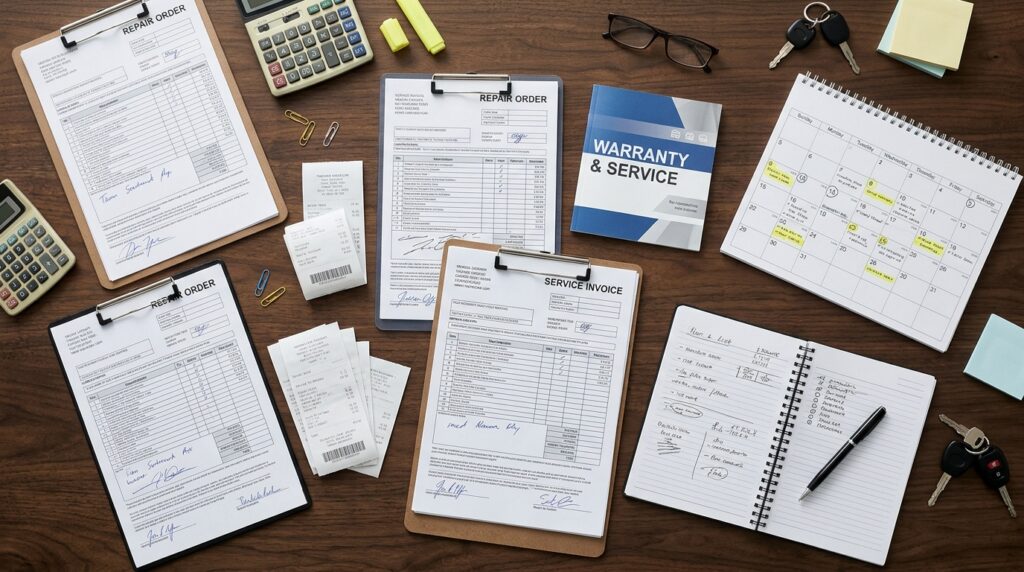
Collect every relevant repair order and place the records in chronological order.
For each visit, record the date, mileage, defect description, diagnostic findings, and service performed.
Identify whether the same problem returned after a repair.
Also, record the time the vehicle spent unavailable because of warranty service.
When a dealer could not reproduce the defect, preserve that record rather than discarding it.
Our intermittent vehicle defects guide explains how these visits may fit into an overall repair timeline.
What Happens During and After Arbitration?
The exact procedure depends on the approved program and the individual dispute.
Some matters involve review of written materials, while others include an opportunity to explain the case in a hearing.
Consumers should follow the instructions supplied by the program and preserve copies of everything submitted.
When a deadline applies, document the date and method of submission.
Understand decisions, acceptance, and other remedies
The arbitrator may determine that the manufacturer’s proposed repair was adequate, that further action is appropriate, or that the evidence supports another authorized outcome.
The available remedies depend on the program and governing law.
Do not assume arbitration always results in a buyback.
Also, read any decision carefully before accepting it.
What to review before accepting an arbitration decision
Review the complete written decision and identify the remedy, deadlines, and conditions.
Check how the decision treats the vehicle, payment obligations, and any other disputed items.
Ask what acceptance means for your ability to pursue additional relief.
The California Department of Consumer Affairs explains that, under state-certified programs, accepting a decision generally makes it binding on the manufacturer.
However, consumers should verify the exact consequences under the relevant program.
Seek legal advice when a settlement or decision involves important rights you do not understand.
How to explain the defect clearly
Describe what happened, when it occurred, and how often the problem returned.
For example, explain that the vehicle stalled during ordinary driving on several dates and underwent multiple warranty inspections.
Include warning messages and repair results where records support them.
Avoid exaggerating the symptoms or assuming that a specific component caused the failure without reliable evidence.
Accuracy improves the usefulness of your presentation.
Include photographs and video carefully
Photos and videos can support a description of an intermittent problem.
However, collect evidence only when safe.
Never operate a phone while driving to record a malfunction.
When a dashboard warning appears, photograph it after stopping in a safe location.
Keep the original files where possible and record the date of each incident.
Do not edit evidence in a way that changes its meaning.
Review the warranty booklet
The warranty booklet identifies covered systems and may explain the manufacturer’s dispute-resolution arrangements.
Different warranties can apply to powertrain components, emissions equipment, and other systems.
Some coverage periods differ by component.
Bring the relevant warranty language when explaining why you believe the defect qualifies.
A dealership’s informal statement that a vehicle is out of warranty should not replace examination of the actual terms.
Keep manufacturer correspondence organized
Save emails, letters, service case numbers, and messages from manufacturer representatives.
Record the date of important telephone conversations and summarize any commitments afterward.
Ask for written confirmation when a representative promises an additional repair or offers a resolution.
Consistent records help establish what each party knew and when.
They can also reduce confusion if the manufacturer assigns a different representative.
Know the difference between mediation and arbitration
Mediation typically involves a neutral facilitator who helps the parties explore a voluntary settlement.
Arbitration usually involves a neutral decision-maker who evaluates the dispute and issues a determination under the program’s rules.
Neither process is identical to a court trial.
Consumers should understand which process a manufacturer or government agency offers before participating.
Some disputes may also involve consumer complaint procedures that do not produce a binding decision.
Understand the newer California lemon law procedures
California adopted significant procedural changes through AB 1755 and SB 26.
Those changes allow certain manufacturers to elect a statutory process involving specific notice and claim requirements.
Arbitration program participation and the statutory opt-in framework are separate issues that consumers should not confuse.
The relevant claim route can affect deadlines and how a dispute proceeds.
For background, read our AB 1755 and SB 26 notice requirements guide.
Do not assume arbitration stops legal deadlines

Participating in informal dispute resolution may interact with statutory timing rules, but consumers should not assume every deadline automatically pauses.
Different claims can involve different limitations periods, notice requirements, and tolling provisions.
Document relevant dates and seek individualized advice when timing becomes important.
Waiting for a manufacturer’s voluntary response may create problems if a separate filing deadline approaches.
Act promptly rather than relying on an unsupported assumption.
What if the manufacturer offers another repair?
During a warranty dispute, the manufacturer may propose additional diagnosis or repair work.
Ask what the repair would involve and how the proposal fits with the existing service history.
Keep written records of the offer and any completed work.
Do not assume that accepting another repair automatically ends all legal rights.
Likewise, do not refuse necessary safety repairs without understanding the consequences.
Professional advice may help when the situation becomes complicated.
Check whether a recall applies
A vehicle recall may identify a safety problem and provide a free manufacturer remedy.
However, a recall does not by itself prove that the vehicle satisfies lemon law eligibility requirements.
The key questions include the actual defect, repair attempts, warranty coverage, and resulting harm.
Our Rivian rearview camera recall guide illustrates how a recall remedy and repeated vehicle malfunctions can require separate analysis.
Prepare for a possible vehicle inspection
Depending on the program, the dispute may involve a vehicle inspection or technical evaluation.
Follow the official instructions and make the vehicle available when required and safe.
Do not alter evidence or attempt to manufacture a malfunction.
Tell the evaluator if a problem occurs only under particular documented conditions.
Provide related repair orders and diagnostic information that may help explain the pattern.
When to consider legal representation
Not every arbitration participant needs an attorney, but some disputes raise complex issues.
These may include contested warranty terms, substantial financial losses, multiple recurring defects, or disagreement about filing deadlines.
A qualified attorney can examine how arbitration interacts with other potential remedies.
Ask about fees, representation scope, and the effect of accepting a proposed settlement.
Do not sign documents you do not understand.
What consumers should remember in 2026
California lemon law arbitration in 2026 provides a structured option for certain warranty disputes.
State certification offers regulatory oversight, but it does not guarantee that every claim will succeed.
Consumers should verify eligibility, organize repair evidence, understand their deadlines, and review any decision carefully.
An informed approach helps protect choices when a vehicle manufacturer and customer disagree about a persistent defect.
Legal disclaimer: This article provides general educational information, not legal advice. Arbitration eligibility and legal deadlines depend on the manufacturer, program, warranty, and applicable California law.