
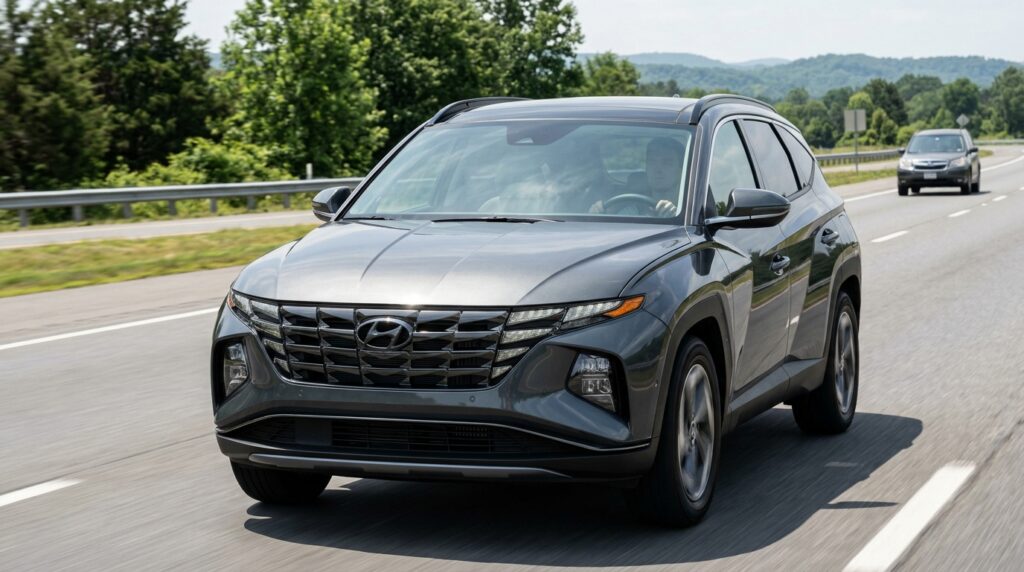
Unexpected braking is particularly concerning because a driver may have little warning before traffic behind the vehicle closes the gap. In 2026, certain Hyundai Tucson SUVs and Santa Cruz pickups became the subject of a federal safety recall involving the software that controls forward collision avoidance. A camera-based safety feature intended to help prevent a crash can, under some conditions, engage the brakes earlier than a driver expects.
The Hyundai Tucson braking recall 2026 illustrates a wider issue in modern vehicles: safety problems can originate in software calibration rather than a visibly broken mechanical part. Hyundai’s recall report, submitted to the National Highway Traffic Safety Administration (NHTSA) in May 2026, identifies 421,078 potentially involved vehicles in its original filing. The affected group spans certain 2025–2026 Tucson, Tucson Hybrid, Tucson Plug-In Hybrid, and Santa Cruz models.
If you own one of these vehicles, checking the recall and arranging its free remedy should come first. But owners who experienced unexpected braking before the repair—or continue experiencing it afterward—may also wonder whether repeated malfunctioning could become a warranty or lemon law issue. That answer depends on evidence and state law, not on the recall announcement alone.
How the 2026 Hyundai Unexpected-Braking Recall Works
Hyundai’s official NHTSA recall report, campaign 26V316, describes a forward collision avoidance system that may be overly sensitive to objects ahead because of its multifunction front-camera software. In certain driving scenarios, the system can respond sooner than expected and apply the brakes. Sudden braking raises the possibility that a closely following vehicle could strike the Hyundai from behind.
Which Vehicles Are Included in Campaign 26V316?
The reported recall population includes certain 2025–2026 Hyundai Tucson gasoline models, Tucson Hybrids, Tucson Plug-In Hybrids, and Santa Cruz pickups. A model name and year do not determine whether one particular vehicle is covered. Production dates and component details matter. Owners should search their individual 17-character vehicle identification number using NHTSA’s official VIN recall tool and confirm the campaign with Hyundai or an authorized dealer.
If the VIN is included, ask the dealer whether campaign 302, the Hyundai designation associated with NHTSA 26V316, has been completed. Maintain a copy of any recall letter and the dealer’s written record. Even when a safety system appears to function normally, a covered vehicle should receive the official remedy because a defect may be intermittent and difficult to predict during daily driving.
What “Phantom Braking” Means in This Context
Drivers often use the phrase “phantom braking” to describe braking they did not expect, but it is not a precise diagnosis. A vehicle may brake unexpectedly because of camera interpretation, sensor alignment, calibration, road conditions, or another problem. The 2026 Hyundai recall concerns a specific software issue, not every complaint involving automatic emergency braking. Avoid assuming that a frightening incident proves which component failed.
Instead, describe exactly what happened: speed, traffic conditions, location, warning messages, whether the driver touched the pedal, and whether the same event happened again. Do not try to reproduce a sudden-braking incident on a public road just to gather evidence.
The Recall Remedy Is a Camera Software Update
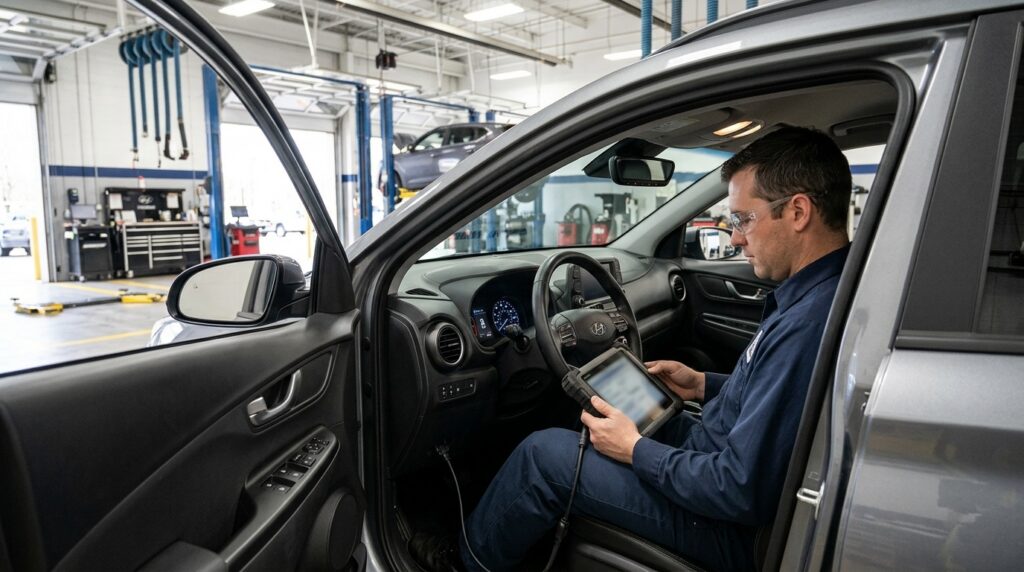
According to the manufacturer’s federal filing, authorized dealers will update the front-camera software without charging affected owners for the recall remedy. The goal is to adjust when the forward collision avoidance function responds. Ask the dealer to confirm that the correct recall update was installed, record the service date and mileage, and provide the final invoice. A software repair is still a repair worth documenting, even when no camera or brake component is physically replaced.
If a dealer says your vehicle needs further inspection, ask what will be checked and whether the additional work is covered. The recall repair itself is free, but other unrelated maintenance may not be. Keep those charges and repair descriptions separate so the record remains clear.
Why Software Recalls Can Be Difficult to Evaluate
Software-dependent defects may appear only in a narrow combination of conditions. A vehicle can behave normally for weeks, then trigger an alert or an unexpected braking event. Sometimes an update resolves the problem entirely. Other times the symptoms continue because a separate sensor, wiring issue, miscalibration, or different fault exists. Owners should not conclude either outcome without observing how their specific vehicle performs after the recall work.
For broader context, see our article on ADAS defects and lemon law claims. Camera-based systems have become important to ordinary vehicle operation, but the legal question remains whether a covered defect has materially affected the particular vehicle and whether the manufacturer received a reasonable opportunity to repair it.
An update may not generate the same paperwork as a replaced transmission or brake component unless an owner asks for it. Request a service invoice showing the campaign number and completed operation. If a symptom recurs, compare the new repair order with the earlier complaint. Consistency in descriptions helps distinguish one recurring problem from unrelated alerts.
Could Repeated Hyundai Braking Problems Support Lemon Law Rights?
A safety recall and a lemon law case are different processes. NHTSA oversees recalls designed to fix safety-related defects for groups of vehicles. State lemon laws generally address qualifying defects that cannot be repaired within a reasonable number of opportunities, subject to coverage requirements and other conditions. A recalled model does not automatically qualify for a repurchase, and a single successful software update may be the end of the matter for many drivers.
Build a Useful Record if Braking Problems Continue

If your vehicle brakes unexpectedly after the recall update, report the recurrence promptly and ask the service advisor to include the relevant details. Note the date and odometer reading, the road environment, dashboard warnings, whether a collision occurred, and whether the dealer could reproduce the behavior. Save photographs taken safely after the event, and keep all manufacturer messages and repair orders in one chronological folder.
Our guide on how to document intermittent defects when the dealer says ‘no problem found’ provides additional recordkeeping suggestions. The goal is accuracy, not dramatic wording. A detailed description can help a technician diagnose the issue and may later help a reviewer determine whether repair opportunities were reasonable.
Count Repair Attempts Carefully
There is no universal number of repairs that guarantees a lemon law victory in every state. Some laws have special presumptions for serious safety defects or a vehicle’s time out of service. Others differ in warranty coverage, notification procedures, and deadlines. A recall update, a diagnostic visit, and an unsuccessful repair may be treated differently depending on the facts and governing rules. An attorney can evaluate the complete sequence rather than relying on an online shortcut.
For a California-purchased vehicle, additional procedural questions may arise under the state’s newer manufacturer opt-in framework. Our California lemon law notice guide provides an overview, while the California Department of Consumer Affairs explains the official framework. Other states may use different processes.
What to Do Before Requesting a Buyback
Start by confirming the VIN and completing any open safety recall. Request a final repair order, even if the dealership charges nothing. If the concern persists, report it again through an authorized repair channel and ask for written findings. Preserve the vehicle’s warranty, purchase or lease agreement, service dates, and records showing how the problem affects normal use. If an unsafe condition remains, seek manufacturer guidance before driving again.
Do not stop car payments, return the vehicle to a dealer without an agreement, or trade it in merely because a recall exists. Financing contracts and vehicle ownership obligations usually continue while a warranty dispute is being evaluated. Before filing a formal claim, check the rules for your state and any notice requirements that apply to the manufacturer. Professional advice is particularly useful where safety incidents, collision losses, or disputed repair records complicate the timeline.
The key takeaway from the Hyundai Tucson braking recall is that modern safety software deserves the same attention as physical hardware. Confirm your vehicle’s status, obtain the free camera update, and keep the service documentation. If unexpected braking continues, the evidence from each visit may become important. Lemon law relief is possible only when the individual facts and applicable rules support it; a recall notice alone does not determine the outcome.
This article is general consumer information, not legal advice. Recall populations, repair availability, and legal requirements should be confirmed with official sources and a qualified professional when needed.