
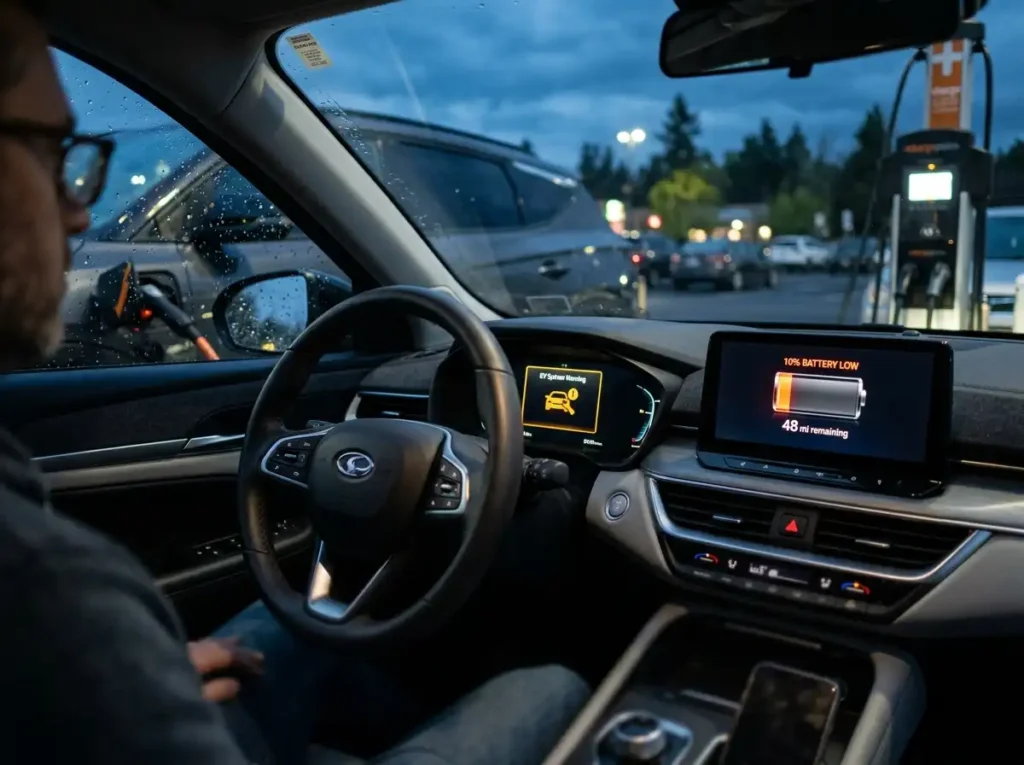
The global shift toward electric vehicles (EVs) has brought incredible technological leaps, instant torque, and the promise of a green driving future. However, as hundreds of thousands of new EVs hit the road, a frustrating and costly battlefield has emerged between automakers and consumers. At the center of this battle is the most expensive component of the vehicle: the lithium-ion battery pack.
For drivers of traditional internal combustion engine (ICE) vehicles, a mechanical defect usually presents itself clearly—a blown head gasket, a transmission that slips, or an engine that refuses to turn over. But in the world of EVs, the defects are often silent, chemical, and digital. A growing number of electric car owners are watching their advertised 300-mile range drop to 180 miles overnight, or finding themselves stranded when their battery percentages plummet without warning.
When automakers push back and claim that severe range loss is simply “normal wear and tear,” it sets the stage for a high-stakes EV battery lemon law dispute. If you are stuck driving an electric car that fails to live up to its promised range, you need to know where the law stands and how to protect your investment.
The Core of the Dispute: Normal Degradation vs. Substantial Impairment
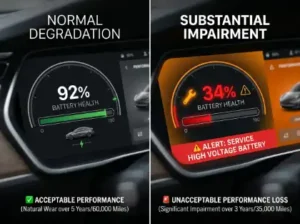 Every electric vehicle battery degrades over time. Just like the lithium-ion battery in your smartphone, an EV battery will slowly lose its ability to hold a full charge as it undergoes repeated charge and discharge cycles. Most automotive manufacturers acknowledge this by offering a separate battery warranty, typically covering the battery pack for 8 years or 100,000 miles, promising a replacement if capacity drops below 70% or 60% during that timeframe.
The legal dispute arises when degradation is sudden, severe, or directly impacts the vehicle’s safe and practical utility. Automakers frequently use the “normal wear and tear” excuse as a shield to deny costly battery replacements. However, state lemon laws protect consumers from vehicles with defects that substantially impair the use, value, or safety of the vehicle.
If you purchased a vehicle specifically because your daily commute requires a 250-mile round trip, and a defective battery pack suddenly limits your vehicle to 150 miles on a full charge, your ability to use the vehicle has been heavily compromised. Furthermore, an EV with a prematurely dying battery suffers a massive hit to its resale value. When a manufacturer refuses to replace a failing battery under warranty, claiming the drop is within “acceptable parameters,” the situation transitions from a standard warranty claim into a legitimate lemon law case.
The “Software Patch” Trap: Throttling Range to Hide Defects
One of the most controversial trends driving modern lemon law litigation is the use of mandatory over-the-air (OTA) software updates to manage volatile batteries. When an automaker detects an inherent stability, thermal management, or fire risk within a specific batch of battery cells, replacing thousands of physical battery packs is incredibly expensive.
To avoid a multi-billion-dollar recall, some manufacturers have deployed software updates that quietly alter the battery management system (BMS). These updates often limit the battery’s maximum charging capacity (for example, capping a full charge at 80% or 90% of its original physical capacity) or severely throttle the speed of DC fast charging to prevent overheating.
The Lemon Law Reality: If a manufacturer forces a software update that permanently reduces your vehicle’s driving range or increases your charging time by 45 minutes just to keep the battery from failing, they have altered the product you originally purchased. This intentional reduction of capability to mask a hardware defect is a prime catalyst for an EV battery lemon law dispute.
How State Lemon Laws and the Magnuson-Moss Warranty Act Apply
If you are facing a severe range dispute, you do not have to rely solely on your local state laws. Consumers are protected by a dual layer of legislation:
- State Lemon Laws: While specifics vary by state, most lemon laws dictate that if a vehicle cannot be repaired after a “reasonable number of attempts” (typically 3 to 4 attempts) for the same substantial defect, or if it spends more than 30 cumulative days out of service at the dealership, the manufacturer must buy it back or replace it.
- The Magnuson-Moss Warranty Act: This federal law governs consumer product warranties. If a manufacturer fails to fulfill the promises made in their written warranty—such as refusing to honor the 8-year/100,000-mile battery coverage for a clearly failing pack—the federal act allows you to sue for damages, and forces the automaker to pay your attorney’s fees if you win.
Signs Your EV Battery Issues Cross the Line Into “Lemon” Territory
Not every cold-weather drop in mileage qualifies as a legal claim. To successfully pursue an EV battery lemon law dispute, your vehicle should exhibit one or more of the following verifiable patterns:
- Sudden, Severe Drops in Range: Losing 30% or more of your available driving range outside of expected seasonal fluctuations (extreme winter cold naturally reduces battery efficiency, but this should return in mild weather).
- Repeated BMS Error Codes: Constant dashboard warnings regarding the electrical system, battery service requirements, or thermal management faults that technicians cannot permanently resolve.
- Rapid Depletion or “Glitched” Percentages: The battery percentage indicator dropping erratically—such as plunging from 40% to 10% in a span of five minutes of normal driving.
- Excessive Days in the Shop: Because EV battery packs are incredibly complex and supply chains remain tightly bottlenecked, dealerships often leave cars sitting for weeks or months waiting for replacement cells or diagnostics. Crossing the 30-day out-of-service threshold frequently triggers automatic lemon status in many jurisdictions.
How to Protect Yourself: Steps for Affected EV Owners
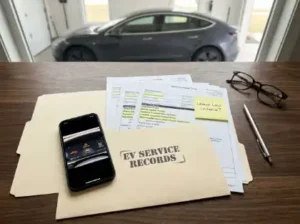 If you suspect your electric vehicle’s range drop is caused by a defective battery rather than normal aging, taking the proper strategic steps immediately will dictate the success of your potential legal claim.
First, document everything. Take photos of your dashboard displaying the fully charged estimated range alongside the odometer. If possible, track your actual driven mileage against the battery percentage drop to prove that the vehicle’s onboard computer is delivering inaccurate data or that the cells are draining prematurely.
Second, demand written repair orders every single time you take the vehicle to the dealership. Ensure the service advisor explicitly writes down your complaint regarding “severe range loss” or “battery degradation.” When you pick up the car, review the paperwork to make sure they recorded what diagnostics were run, what firmware updates were applied, or if they simply stated “could not replicate defect.” Do not leave the dealership without an official copy of the invoice.
Finally, do not wait out the warranty period. The moment a manufacturer tells you that a 40% loss in mileage on a year-old vehicle is “completely normal,” consult with an experienced consumer protection attorney. Manufacturers rely on consumers giving up out of frustration, but an authoritative legal approach is often the only way to compel an automaker to execute a full buyback.
Conclusion: Take Charge of Your Consumer Rights
Purchasing an electric vehicle is a major financial commitment, and you are legally entitled to the performance, safety, and reliability promised when you signed the contract. A manufacturer cannot hide behind the veil of complex software or changing battery chemistry to deny you the warranty coverage you paid for. If your electric car’s battery has turned your daily commute into an exercise in range anxiety, it is time to stop fighting the dealership and start exploring your legal options under the lemon law.