
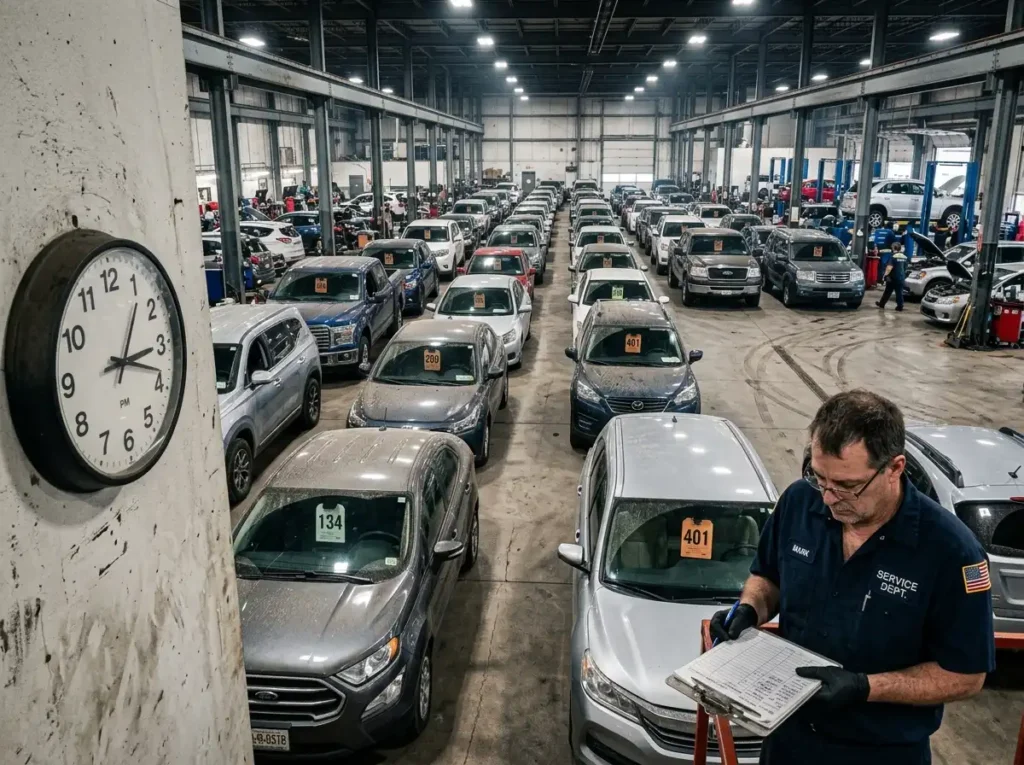
When most people think of a “lemon” vehicle, they picture a car that repeatedly breaks down on the highway or a stubborn mechanical defect that a technician simply cannot fix. Consumers often expect that to win a lemon law case, they must endure the frustration of bringing their vehicle back to the dealership service bay four or five separate times for the exact same issue. While this multiple-attempt scenario is a common path to a consumer buyback, it is not the only one. There is another, powerful legal mechanism designed to protect consumers from a completely different type of frustration: endless dealership delays.
In the modern automotive market, a vehicle does not necessarily need to undergo repeated, failed physical repairs to be legally declared a lemon. Instead, it can qualify based purely on the clock. Known across most jurisdictions as the lemon law 30 day rule, this statutory provision establishes that if a vehicle sits idle in a repair shop for too long, it is a substantial impairment to the owner’s use and value. As global supply chain backlogs continue to plague automakers, leaving critical microchips, specialized wire harnesses, and electric vehicle battery components stranded overseas, this time-based rule has become an essential lifeline for consumers stuck in dealership limbo.
Demystifying the 30-Day Presumption: It’s About Time, Not Attempts
 The core philosophy behind state and federal consumer protection laws, including the Magnuson-Moss Warranty Act, is that when you purchase a warranted product, you are buying the right to use it. If a vehicle spends a massive portion of its early lifespan sitting on a dealership lot rather than in your driveway, the manufacturer has failed to fulfill its end of the warranty contract.
To address this, lawmakers created the 30-day out-of-service presumption. While specifics can vary slightly by state, the standard rule dictates that if a vehicle is out of service for a cumulative total of 30 days or more within a specific window—usually the first year or two of ownership, or within the vehicle’s bumper-to-bumper warranty period—the vehicle is legally presumed to be a lemon. Once this 30-day threshold is crossed, the burden of proof frequently shifts from the consumer to the manufacturer. It is no longer up to you to prove the car cannot be fixed; the law presumes the vehicle is a lemon because the manufacturer has taken an unreasonable amount of time to return a functional product to your hands.
The Backorder Trap: Why Dealership Excuses Do Not Stop the Clock
If you have a car currently sitting at a dealership service center, you are likely intimately familiar with the “Backorder Trap.” Service advisors frequently shrug their shoulders, point to empty parts shelves, and offer a variations of the same script: “We know exactly what is wrong with your vehicle, and we really want to fix it for you. However, the replacement module is stuck on a container ship, backordered at a factory overseas, or delayed by global logistics. There is absolutely nothing we can do, so you just have to wait.”
While these supply chain disruptions may be a genuine headache for the automotive industry, from a legal perspective, they are entirely the manufacturer’s problem. The lemon law 30 day rule does not contain a “supply chain exception.” The statutory clock does not pause because a part is hard to find, nor does it halt because a dealership is short-staffed or waiting on a specialized technician to arrive from a corporate regional office. The law is indifferent to *why* the vehicle cannot be driven; it only cares that the consumer is being deprived of the vehicle they are paying for. If the manufacturer cannot source the components necessary to repair your vehicle within the legally mandated timeframe, they are obligated to buy it back or replace it.
Tracking Cumulative vs. Consecutive Days
A critical point of confusion for many vehicle owners is how those 30 days are calculated. A common misconception is that the car must sit in the shop for 30 consecutive, uninterrupted days for the rule to apply. While a single 30-day block absolutely qualifies, the law explicitly states that these days are cumulative.
This means you can piece together multiple independent, shorter service visits to reach the magic number. Consider this scenario:
- Visit 1: Your car suffers a transmission glitch and spends 10 days at the dealership before they apply a temporary software patch and hand it back.
- Visit 2: Two months later, an electrical malfunction causes the digital dashboard to go dark. The car sits at the shop for 12 days while technicians troubleshoot the wiring harness.
- Visit 3: A month after that, a sensor fails, requiring another 9 days in the service bay waiting for a replacement part.
In this example, the vehicle was never in the shop for 30 consecutive days. However, adding the visits together (10 + 12 + 9) equals 31 cumulative days out of service. Because the total exceeds the statutory 30-day limit within the qualifying warranty period, the vehicle can be legally classified as a lemon, giving the owner the right to demand a buyback.
Crucial Documentation Strategies for Vehicle Owners
 Because time-based lemon law claims rely entirely on calendar precision, your success depends heavily on airtight documentation. Dealerships are well aware of the 30-day rule, and internal systems are sometimes optimized to make a vehicle’s time in the shop look shorter on paper than it actually was. To protect your rights, implement these tracking habits immediately:
- Always Demand an “In” and “Out” Date: Never drop off your vehicle without ensuring a formal repair order is opened immediately with the correct date and time stamp. When you pick up the vehicle, ensure the service advisor prints a final invoice that clearly reflects the exact date the vehicle was returned to you.
- Beware of the “Bring It Back Later” Strategy: If a dealership tells you a part is on backorder and asks you to drive a partially broken, potentially unsafe vehicle until the part arrives, be careful. Days spent driving the vehicle while waiting for a part usually do not count toward the 30-day out-of-service threshold. If the car is unsafe or materially impaired, insist on leaving it at the dealership and demand a loaner vehicle. If they refuse to keep it, document in writing that you are driving a compromised vehicle under protest due to part unavailability.
- Keep an Independent Log: Maintain a personal calendar tracking the exact dates and times the vehicle was physically out of your possession. Back this up with text messages, emails, or phone logs showing when you called for updates and when you were notified that the vehicle was ready for pickup.
The Ultimate Remedy: What Happens When You Win?
If your vehicle crosses the 30-day threshold and meets your state’s specific criteria, you are legally entitled to a lemon law remedy. The most common and financially beneficial outcome is a full manufacturer buyback. Under a buyback, the automaker is required to refund the full purchase price of the vehicle, including your down payment, all monthly finance payments made to date, registration fees, and even incidental costs like towing fees or rental car expenses.
The manufacturer is allowed to deduct a small, legally calculated “usage allowance,” which reflects the value of the miles you drove the car *before* the first major defect occurred. However, given how quickly modern vehicles end up sitting in service bays early in ownership, this deduction is typically minimal. Alternatively, you can opt for a brand-new replacement vehicle of a similar make and model. The bottom line is simple: you do not have to accept a vehicle that lives at the dealership. If global supply chains are keeping your car off the road, let the lemon law hold the manufacturer accountable.