
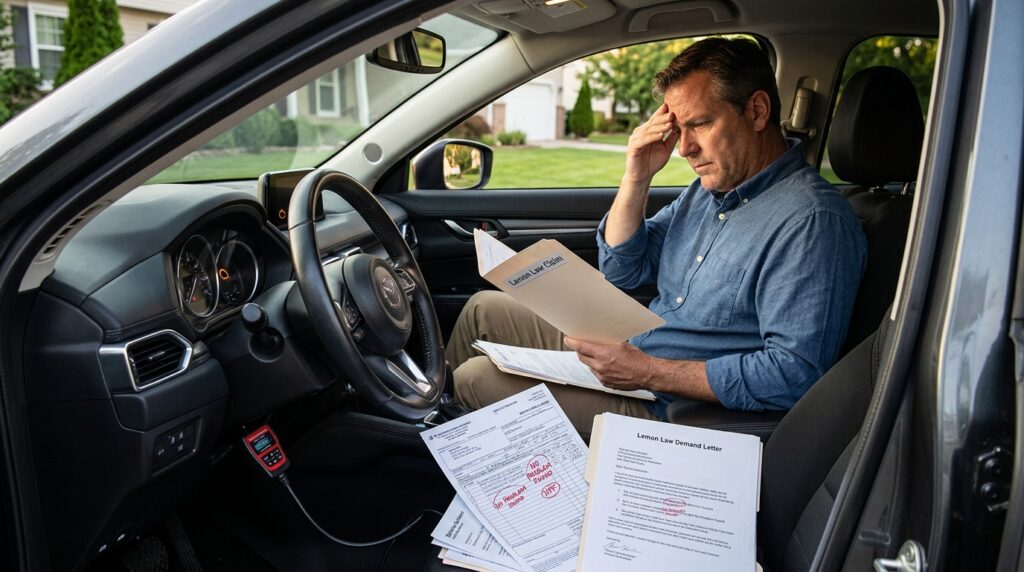
One of the most frustrating things a car owner can hear from a dealership is “no problem found.” You know the vehicle stalled, shook, flashed warning lights, lost power, failed to start, or had a safety system shut off. But when the dealer inspects it, the problem does not appear, intermittent vehicle defects lemon law. The repair order may say “could not duplicate concern,” “operates as designed,” or “no fault found.”
That does not automatically mean your complaint is invalid. Intermittent vehicle defects are real, and they can be some of the hardest problems to diagnose. Modern vehicles rely on sensors, modules, wiring, cameras, software, batteries, and electronic control systems. A defect may appear only under certain conditions, such as cold starts, hot weather, rain, highway speeds, stop-and-go traffic, low battery voltage, or after a software update.
For lemon law purposes, documentation is everything. If the same problem keeps happening but the dealership keeps saying it cannot reproduce the issue, you need to build a clear record. A strong timeline can help show that the defect is repeated, serious, and connected to the vehicle’s use, value, or safety. This article explains how to prove intermittent vehicle defects when the dealer says “no problem found.” This is general information only, not legal advice.
Why Intermittent Vehicle Defects Are So Difficult
Intermittent defects are difficult because they do not happen on command. The vehicle may act normal during a short dealership test drive but fail again the next morning. A dashboard warning may disappear after restarting the vehicle. A transmission hesitation may happen only after the car warms up. An electrical issue may occur only during rain or after the vehicle sits overnight.
This creates a documentation problem. The driver experiences the defect, but the technician may not see it. The manufacturer may later argue that no repair was needed because the dealer could not confirm the issue. That is why drivers should not rely only on verbal complaints. Every incident should be recorded, reported, and tied to a repair visit when possible.
“No Problem Found” Does Not Mean No Problem Exists

A “no problem found” note means the technician did not confirm the concern during that visit. It does not prove the vehicle is defect-free. There is a big difference between “the issue does not exist” and “the issue did not happen while the car was at the dealership.”
This distinction matters for lemon law claims. A recurring defect may still affect the vehicle even if the dealer cannot duplicate it every time. For example, a vehicle that randomly stalls, loses power, disables safety warnings, fails to charge, or shows brake system errors can create serious safety and reliability concerns. If those issues keep returning, the repair history may still matter.
Common intermittent defects drivers should take seriously
Some intermittent problems are more than annoyances. Engine stalling, transmission slipping, brake warnings, steering issues, battery failures, electrical shutdowns, backup camera blackouts, blind-spot monitor failures, lane-assist warnings, charging errors, and repeated check engine lights should be documented carefully.
These issues may affect how safely or reliably the vehicle can be used. Your site’s article on common defects that qualify for lemon law claims is a good related resource because it explains why repeated engine, transmission, braking, steering, suspension, and electrical problems may support a claim.
Software defects can be especially hard to reproduce
Software-related defects are becoming more common in modern vehicles. A problem may appear after an over-the-air update, disappear after a reset, then return later. The dealership may install another update and call the issue resolved, but the same warning may come back days or weeks later.
This is why software repairs should be documented just like physical repairs. If a dealer updates a module, resets a system, recalibrates a camera, or installs new software, ask for the repair order to state exactly what was done. For more information, read Over-the-Air Updates and Software Defects: Could Your Vehicle Qualify Under Lemon Law?.
How to Document an Intermittent Defect
The best way to prove an intermittent defect is to create a consistent record. Do not wait until the problem happens ten times before taking action. Start documenting immediately. Write down the date, mileage, location, weather, driving conditions, warning messages, and what the vehicle did. If the car stalled, note whether it restarted. Warning light disappeared, note when it disappeared. If a safety feature stopped working, write down which feature failed.
Photos and videos can help, but only if captured safely. Do not record while driving if it puts you or others at risk. If a warning message appears while parked, take a clear photo. If the vehicle fails to start, record a short video showing the key, dashboard, and sound. The backup camera goes black, take a photo of the screen. These small pieces of evidence can support your repair history.
Make the dealership write the complaint clearly
When you bring the vehicle in for service, be specific. Do not say, “The car is acting weird.” Say what actually happened. For example: “Vehicle lost power while merging onto the highway,” “rear camera screen went black while reversing,” “brake warning appeared three times this week,” or “transmission hesitates between second and third gear after warm-up.”
Before leaving the dealership, review the repair order. If the document does not describe the problem accurately, ask for it to be corrected. Vague repair records can hurt your claim. A repair order that says “customer states issue” is weaker than one that describes the actual defect, mileage, warning message, and driving condition.
Keep every repair order, even if nothing was fixed
Many drivers throw away repair orders when the dealer says nothing was found. Do not do that. A “could not duplicate” repair order still proves that you reported the problem. If the same complaint appears across multiple visits, those records may show a pattern.
Keep repair invoices, inspection notes, diagnostic reports, recall documents, software update records, text messages, emails, rental receipts, towing receipts, and appointment confirmations. Also keep your own defect log. The goal is to show that the issue was not a one-time complaint. It was repeated, reported, and unresolved.
What to Do If the Dealer Keeps Dismissing the Problem
If the same intermittent defect keeps returning, do not accept vague explanations forever. Schedule service again, but be prepared. Bring your defect log, photos, videos, and previous repair orders. Ask whether the technician can perform a longer test drive, inspect related systems, check technical service bulletins, scan stored fault codes, review freeze-frame data, or escalate the issue to the manufacturer’s technical support team.
It may also help to visit another authorized dealership for the same manufacturer. A different service department may take the complaint more seriously or spend more time diagnosing the issue. However, keep all records from every dealership. Your timeline should show the full repair history, not just one location.
When an Intermittent Defect May Support a Lemon Law Claim

An intermittent defect may support a lemon law claim when it is covered by warranty, keeps recurring, and substantially affects the vehicle’s use, value, or safety. The exact requirements depend on state law, the vehicle type, warranty coverage, repair history, and timing. Some claims involve repeated repair attempts. Others involve long out-of-service time. Safety-related defects may be treated more seriously because they create greater risk.
Drivers should also consider whether the problem connects to a recall, safety complaint, or known defect pattern. If the issue involves safety, consumers can report it through the NHTSA vehicle safety complaint system. A safety complaint is not the same as a lemon law claim, but it creates an official record and may help regulators identify broader defect trends.
For claim preparation, read How to File a Lemon Law Claim. If your vehicle has spent extended time at the dealership because the dealer is waiting for parts, diagnostics, or manufacturer guidance, also review The 30-Day Rule and Global Supply Chain Backlogs.
The most important rule is simple: do not let “no problem found” end the conversation when the defect keeps happening. A dealership may fail to duplicate an intermittent problem, but your documentation can still show a pattern. The stronger your records, the harder it becomes for the manufacturer to dismiss the issue as random, minor, or imagined.
If your vehicle keeps failing, keep reporting it. Save every document. Capture safe evidence. Make the dealership describe the complaint clearly. Track the mileage and dates. An intermittent defect can be hard to prove, but it is not impossible. With the right repair history and documentation, a “no problem found” case can still become a serious lemon law claim.