
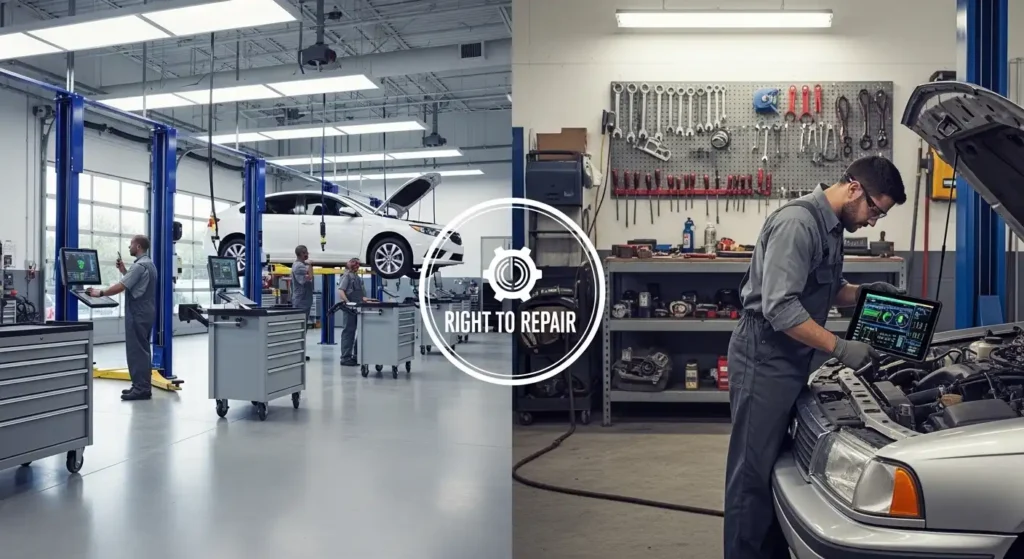
The most pressing question for California drivers this year is: “If I take my car to a local mechanic to fix a recurring issue under these new laws, am I accidentally voiding my Lemon Law protections?” The answer is nuanced, and understanding the boundary between your right to repair and your right to a refund is critical to protecting your multi-thousand-dollar investment.
The Evolution of the Right to Repair in 2026
 The 2026 California Right to Repair updates were specifically designed to break the monopoly dealerships held over modern, “computer-on-wheels” vehicles. Until recently, if a sensor failed or a transmission software glitch occurred, only a branded dealership had the “digital keys” to access the onboard computer and perform the fix. This often led to long wait times and inflated labor costs.
Under the current law, you have the absolute legal right to choose where your vehicle is serviced. However, the California Lemon Law (Song-Beverly Consumer Warranty Act) operates on a specific set of rules regarding “reasonable repair attempts.” This is where the conflict between your freedom to choose a mechanic and your right to a buyback begins.
The “Authorized Repair” Trap: How Manufacturers Fight Back
To qualify for a Lemon Law buyback or replacement, the law generally requires that the manufacturer (via its authorized dealerships) be given a “reasonable number of attempts” to fix the defect. In 2026, a new defense strategy has emerged among auto manufacturers: denying Lemon Law claims by arguing that an independent shop’s intervention “interfered” with the factory-standard systems.
Magnuson-Moss vs. California Lemon Law
It is important to distinguish between two different legal protections:
- The Magnuson-Moss Warranty Act (Federal): This protects you from having your warranty voided simply because you used an aftermarket part or an independent mechanic for routine maintenance.
- The Song-Beverly Act (California Lemon Law): This requires the manufacturer to fail at fixing a “nonconformity.” If an independent shop attempts to fix the specific defect you are complaining about, the manufacturer may argue that their “attempts” were never officially exhausted because a third party touched the system first.
When to Use an Independent Shop (and When to Avoid It)
In 2026, your strategy for car maintenance should be divided into two distinct categories to ensure you don’t lose your “Lemon” status.
1. Safe for Independent Shops: Routine Maintenance
Thanks to Right to Repair, you can—and should—use independent shops for non-warranty related items. These do not impact your Lemon Law rights:
- Oil changes and fluid flushes.
- Brake pad and rotor replacements.
- Tire rotations and alignments.
- Aesthetic repairs or non-mechanical bodywork.
2. Dealership-Only: Recurring Warranty Defects
If your car is experiencing a recurring defect—such as transmission slipping, engine stalling, or persistent electrical “ghosts”—you must take it to an authorized dealership. Why? Because under California law, only repair orders from an authorized dealer count as official “repair attempts.” If you have five unsuccessful repairs at a local shop, you have a headache. If you have those same five repairs at a dealership, you have a Lemon Law case.
“The Right to Repair gives you the freedom to choose your mechanic, but the Lemon Law requires the manufacturer to take responsibility for their factory mistakes. Don’t let a manufacturer shift the blame for a lemon onto your local mechanic.”
The Risk of “Software Tampering” Claims in 2026
 With the 2026 laws granting independent shops access to vehicle software, a new risk has emerged. If an independent mechanic “re-flashes” a control module or updates software to fix a stalling issue, a manufacturer may later claim that this unauthorized software modification caused the very defect you are suing over.
Even if the mechanic is highly skilled, the “chain of custody” for the vehicle’s software is broken. In a Lemon Law trial, the manufacturer’s lawyers will use this to create “reasonable doubt” about whether the defect was a factory flaw or a result of third-party software interference.
Practical Steps to Protect Your Rights
If you suspect your vehicle is a lemon, but you still want to exercise your Right to Repair for general service, follow these protocols:
- Separate the Work: Never allow an independent shop to troubleshoot the specific defect that is the basis of your lemon claim. If the car jerks when shifting, take it to the dealer for that issue, even if you go to your local mechanic for the oil change.
- Demand Detailed Invoices: Under 2026 regulations, shops provide digital invoices. Ensure yours explicitly states that no modifications were made to the powertrain or safety software if the work was routine.
- The “First Attempt” Rule: Always ensure the very first time a defect appears, it is documented by a dealership. This establishes the “date of discovery” within the manufacturer’s own system.
- Diagnostic Logs: Many 2026 independent shops now provide “health reports” via OBD-III. Keep these! If an independent shop identifies a fault code that the dealership “can’t replicate,” that report is gold for your Lemon Law attorney.
Conclusion: Knowledge is Your Best Defense
California’s Right to Repair is a powerful tool for consumer freedom and market competition, but it is not a substitute for Lemon Law protections. As we navigate the complex automotive landscape of 2026, remember that the dealership is where you document the manufacturer’s failure, while the independent shop is where you maintain your vehicle’s longevity.
Are you driving a vehicle that won’t stay fixed? Even if you have already visited an independent shop for repairs, you may still have a valid claim. The intersection of these laws is complex, and you need a legal team that stays ahead of the latest 2026 legislative shifts.